
Composition in photography: how to bring clarity to your images
Photography can feel confusing when everything seems worth capturing but nothing quite comes together. Here, we explain how we approach composition at Pentaprisma: working with your images to understand what matters and build clarity from the inside.

Composition begins with deciding what matters
If you have ever felt that your photographs contain something interesting but do not quite come together, it is often because several elements are competing at once, and all of them seem to ask for the same level of attention. You notice one thing, then another, and both feel worth including, so the frame fills up quickly without the image becoming any clearer.
What tends to be missing in that moment is not sensitivity, but hierarchy. Everything is present, but nothing quite settles, and the photograph remains slightly open, as if it had not fully decided what it is about. That is usually the point where composition begins to matter, because the question is no longer what you see, but what actually holds the image together.
This is something we encounter constantly during our workshops, and it is also part of how we work. The photograph is not empty, but it lacks a clear centre. And it is precisely from there that the work begins.
In practice, this can take different forms. Sometimes it has to do with choosing a single subject and allowing it to dominate the frame. Other times it is about recognising which elements are supporting that subject and which are simply adding noise. Learning to make that distinction — even if only partially at first — is what starts to give the photograph a clearer direction.
Composition is not separate from meaning
Once that question appears — what is really carrying the photograph — it becomes difficult to treat composition as something secondary.
It is often described as an arrangement, as if the subject already existed in a fixed form and the task were simply to organise it, but in practice the way the frame is built is already shaping how the image is understood. Decisions such as how close you stand, what you allow to enter the edges of the frame, or how different elements relate to each other are not neutral; they influence what becomes more present and what recedes.
This is easier to see in simple situations. The same subject can feel distant or intimate depending on how much space surrounds it. A small shift in framing can turn something descriptive into something more direct. Even the decision to include or exclude a secondary element can reinforce or dilute what the photograph suggests.
From that point on, composition is no longer something you apply to the image. It is already embedded in the way you are building it.

A photograph becomes clearer when attention has somewhere to go
Seen in this way, composition becomes easier to recognise in the images themselves. When a photograph feels resolved, it is often because the eye finds a place to settle, even if only briefly, before moving through the rest of the frame.
This does not necessarily mean simplifying everything to a single element, but it does require some form of organisation. There is usually a main point of attention, supported by other elements that do not compete with it in the same way. When that structure is not there, the experience changes: the eye moves, but without finding a point of rest, and the image begins to feel scattered.
In our sessions, this is often where the first real shift happens. The moment when the image stops being something you “took” and becomes something you start to understand.
Working on this can take different directions. Sometimes it is about reinforcing a main subject so it clearly stands out. Other times it involves adjusting how secondary elements are arranged so they guide the eye rather than distract it. It can also mean using the edges of the frame more deliberately, so attention does not escape too easily. In all cases, what is being shaped is not the subject itself, but the way attention moves within the photograph.
The background is never neutral
Once you begin to notice how attention behaves, it becomes difficult to ignore everything that interferes with it.
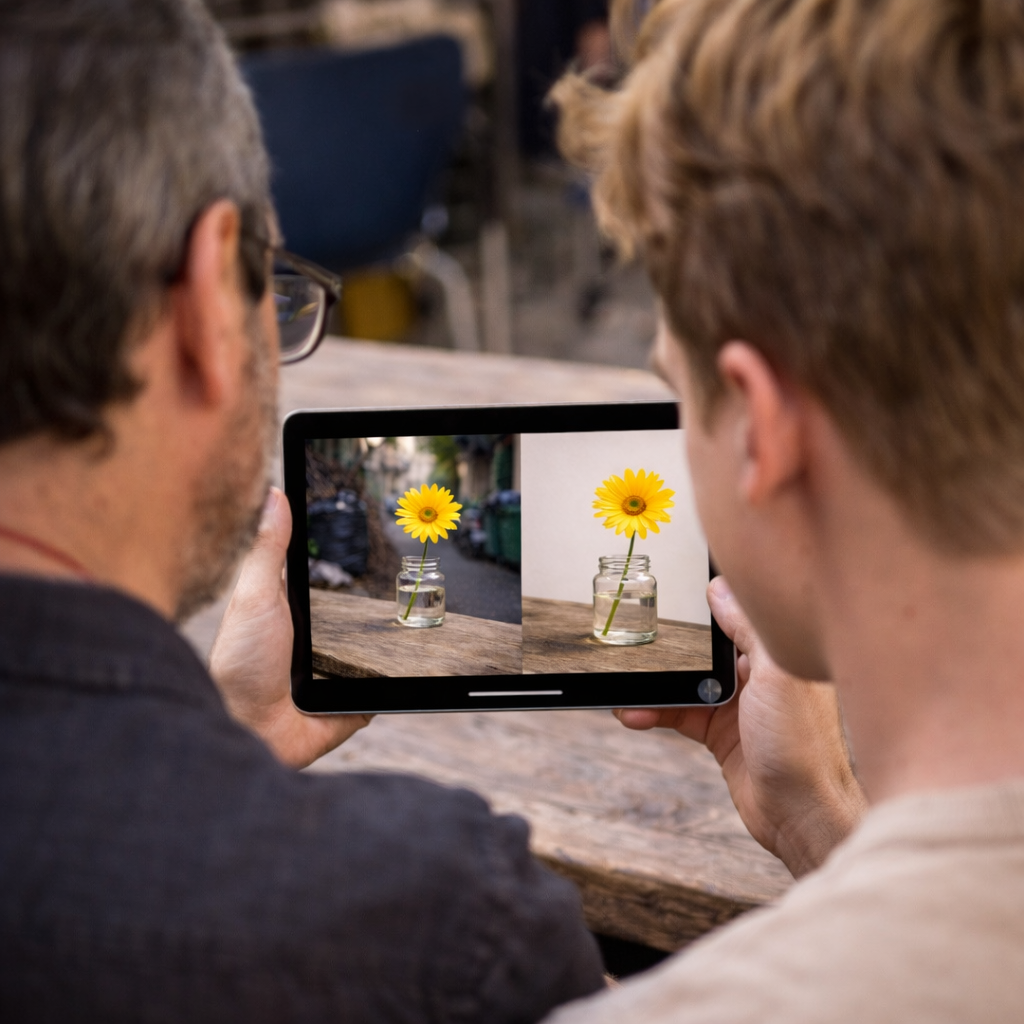
Even when it is not the main subject, the background is always influencing the image. It can support what you are trying to show, or it can quietly weaken it by introducing elements that compete for attention, repeat shapes in an unhelpful way, or create a level of visual noise that makes the photograph harder to read.
Resolving this rarely requires a completely different scene. More often, it comes down to how you position yourself. A small step to one side can separate the subject from a distracting background. Changing your distance can compress or open up the space. Adjusting your angle can eliminate overlaps that were not obvious at first.
These are relatively simple adjustments, but they tend to have a strong effect on the clarity of the image. It is also where many people realise that composition is not something abstract, but something you can actively work on while photographing.
Good composition often depends on what you leave out
That question has to do with necessity.
When you look at a photograph that feels slightly overloaded, it is often because too many elements remain in the frame without all of them contributing in the same way. At first, everything may have seemed relevant, but as the image develops, it becomes clearer that some parts are not adding much, and may even be making it harder to read.
Simplifying the image is not about reducing it for aesthetic reasons, but about removing what does not support it. This can involve excluding elements at the edges, tightening the framing, or choosing a moment where fewer things are happening. It can also mean rethinking how much space each element needs in order to be seen clearly.
As that simplification happens, the photograph usually becomes easier to understand. What remains starts to stand out with more clarity, and the image begins to feel more deliberate. That is often the moment when the process becomes more intentional.
What changes when you move only a little
Instead of looking for something new, you begin to explore what is already there with more attention.
Very often, the difference between an image that feels unresolved and one that holds together lies in small adjustments. Moving slightly closer can strengthen the relationship between elements. Stepping back can introduce space and make the structure more legible. Changing your height can alter how subjects overlap, and with it, how clearly they are perceived.
These are the kinds of variations we work with constantly during our workshops. Not as theory, but as something you can see immediately in your own photographs.
These adjustments tend to fall into a few recurring areas: how distance affects the connection between elements, how a change in point of view reorganises the frame, or how subtle shifts in position can improve balance and separation. They are simple ideas, but they open up a way of working that is much more precise.
And once you start to see how much can change without leaving the scene, it becomes easier to stay with it a little longer and continue refining the image instead of replacing it.

Depth, lines and structure are ways of making a flat image come alive
As you begin to work more deliberately within the frame, other aspects of composition become more visible.
Photography translates a three-dimensional space into a flat surface, and without some form of structure, that translation can feel incomplete. The image may appear static, or difficult to navigate, not because there is nothing in it, but because the relationships between elements are not clearly defined.
Depth, lines, layers and directional elements help organise that space. They can guide the eye through the image, connect different parts of the frame, or create a sense of movement that makes the photograph more dynamic. Sometimes this comes from how elements are aligned; other times from how they overlap or recede.
These are not techniques to apply in isolation, but ways of understanding how the image is built from within.
Air matters
As structure becomes clearer, space begins to play a more active role.
The area around a subject is not empty; it defines how that subject sits within the frame and how it relates to everything else. Too little space can make the image feel constrained, while too much can make it lose focus. Finding the right balance often involves small adjustments in framing rather than large changes in the scene.
This is also where ideas such as leaving space in the direction of movement, or allowing a subject to “breathe” within the frame, begin to make sense. They are not rules to apply mechanically, but ways of adjusting how the image feels as a whole.
Balance is not symmetry
From there, balance becomes easier to understand in more flexible terms.
It is often associated with symmetry, but in practice it has more to do with how visual weight is distributed across the frame. A strong element on one side can be balanced by something quieter on the other, or even by space itself. What matters is not that both sides are equal, but that the image holds together without feeling unstable.
This can be explored in different ways: by introducing a secondary element that compensates for a dominant one, by adjusting how much space surrounds different parts of the image, or by slightly repositioning yourself so that elements relate to each other more coherently.

Patterns become photographs when something breaks them
In some situations, the structure of the image comes from repetition.
Patterns can create a strong visual rhythm, but on their own they do not always sustain attention. What often gives them meaning is a variation within that repetition — something that does not fully follow the pattern.
That difference can be introduced in many ways: a change in shape, a shift in position, a variation in light, or simply an element that does not belong in the same way as the others. It creates a point of focus within the repetition and gives the eye a reason to stay.
You do not learn composition by memorising rules
At this point, it may seem that all of these ideas could be organised into a set of principles to remember.
But in practice, composition does not tend to work that way. Knowing rules can be useful, but it does not necessarily make it easier to apply them in real situations, where multiple things are happening at once.
What usually makes a difference is working with actual images, comparing variations, and gradually recognising why one version feels more resolved than another. This is also why we place so much emphasis on reviewing your own photographs during the workshops.
Over time, that builds a form of understanding that is less about recalling rules and more about seeing relationships more clearly.
Seeing composition more clearly
As these elements begin to connect, something shifts in how you approach photography.
Decisions that once felt uncertain start to make more sense, not because there is more information, but because the image becomes easier to read from within. Composition no longer feels like something that needs to be applied afterwards, but something that is already present from the moment you begin to frame.
From there, the process becomes more fluid and more deliberate at the same time. You are not adding more to the photograph, but understanding better what is already there and how to shape it.
This is, in essence, what we aim to develop in our workshops: a way of working that allows you to see more clearly and make more intentional decisions, even in situations that initially feel complex.
Where workshops take place
Pentaprisma workshops are currently offered in the following cities where outdoor environments allow calm observation and practical learning.
Barcelona
Workshops in Barcelona take place in walkable areas that allow steady practice and attentive observation. The city’s rhythm supports a balanced approach between structure and creative exploration.
Gran Canaria
In Gran Canaria, workshops benefit from consistent light and open environments. The island offers calm, accessible spaces ideal for focused practice and gradual understanding.
Madrid
Madrid provides varied urban scenes, strong geometry, and changing light. Workshops here focus on building clarity while working in dynamic but accessible environments.
Berlin
Berlin offers layered spaces, texture, and seasonal light that invite careful observation. Workshops are designed to use the city’s character as a framework for structured learning.